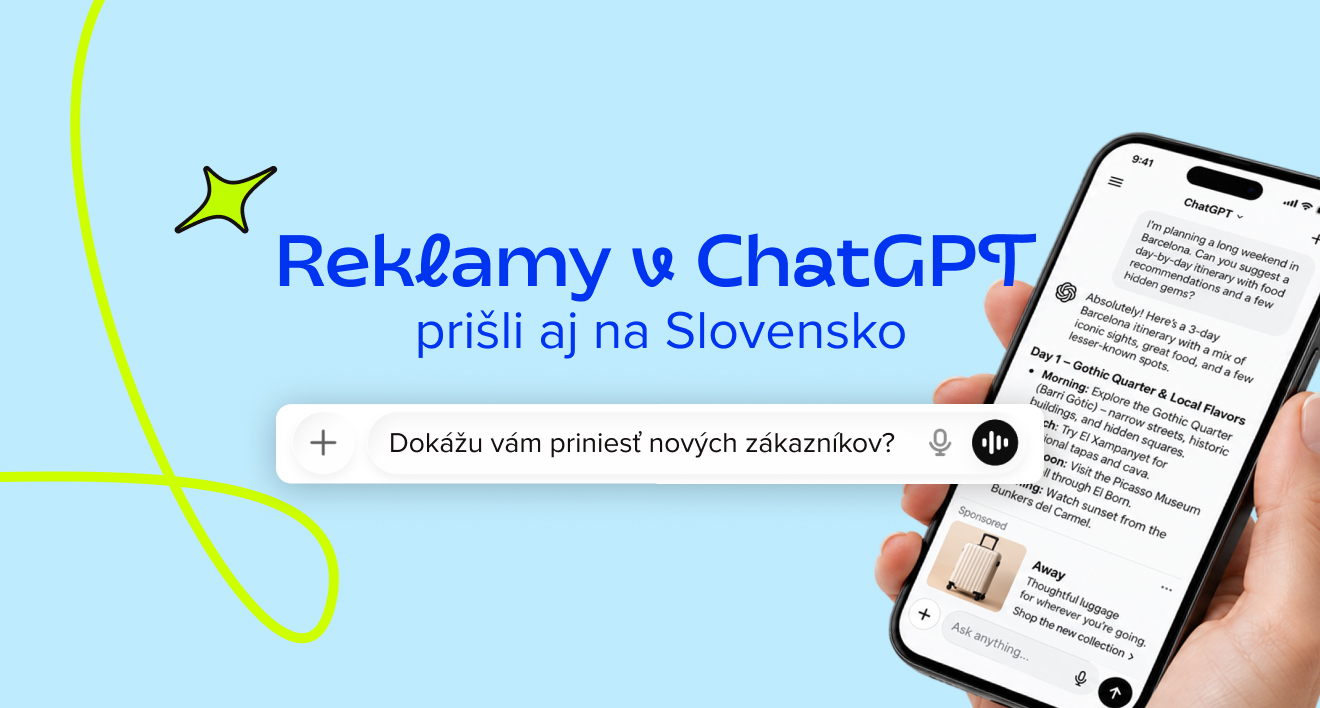
ChatGPT Ads are now available in Slovakia. In this article, we explain how advertising works within conversations, what information the system uses when selecting which ads to show, and which types of products may benefit most from this new channel.
According to the latest data, 2.7 million Slovaks aged 14–79 actively use AI tools. As many as 83% of AI users turn to them when looking for information. Instead of relying solely on traditional search, people are increasingly asking AI directly about products, available options and the differences between them. Part of the buying decision process is therefore moving straight into the chat window.
OpenAI is now adding another layer to this environment. It has made its self-service ChatGPT Ads Manager available to Slovak companies, and the system takes the context of the current conversation into account when selecting which ads to show, including what the user is currently trying to solve. For marketers, the key question will be whether this additional context can generate higher-quality traffic, more relevant leads or more customers.
OpenAI began testing ads in ChatGPT in the US on February 9. Since August 31, Ads Manager has also been available in 31 European markets, including Slovakia.
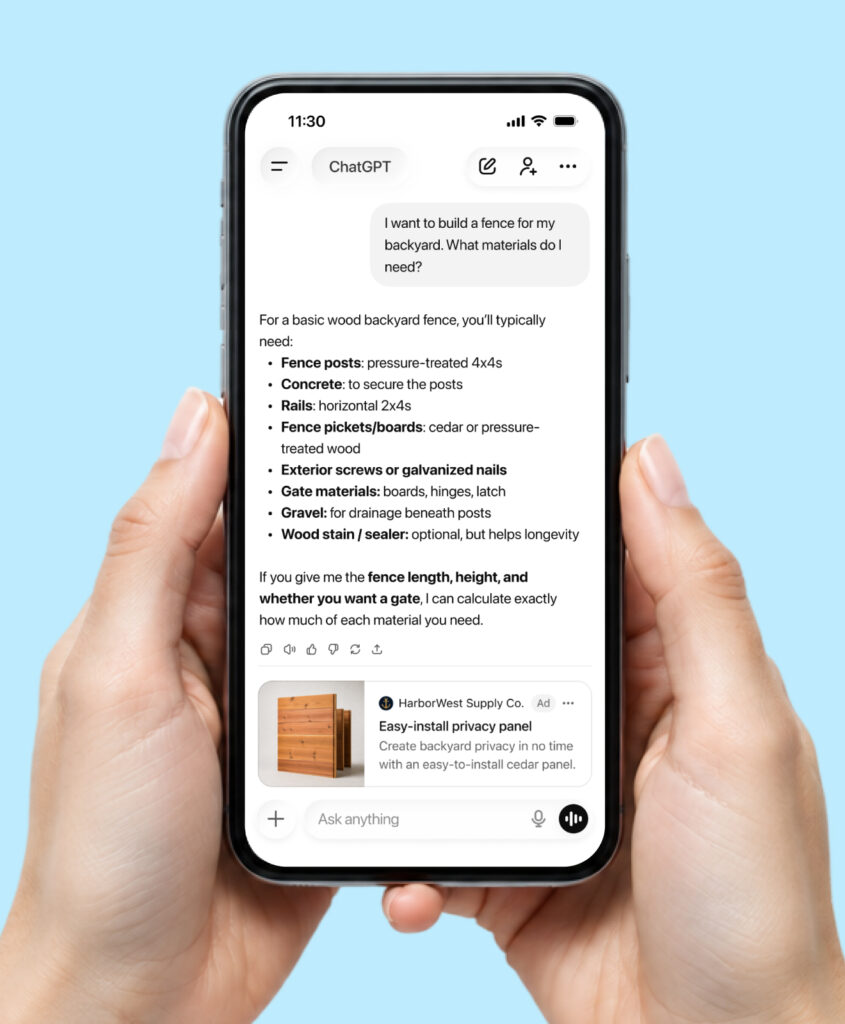
Ads appear below ChatGPT responses as clearly labelled sponsored content. They do not influence the model’s answer, and companies cannot pay to be directly recommended by ChatGPT. OpenAI also does not share users’ conversations or personal data with advertisers.
ChatGPT is used by more than one billion people every week, and according to OpenAI, hundreds of millions of people use it to discover, understand and compare products. OpenAI now explicitly describes ChatGPT as a place where people begin product research, compare different options and work out what to choose.
Conversation Context Reveals More Than a Single Search Query
Search advertising is driven mainly by what someone types into a search engine. If they search for “CRM for a small business”, we can make a fairly accurate assumption about what they are looking for. What we still do not know is the broader situation behind that search.
In ChatGPT, the same question may be preceded by several messages. A user might explain that they have five salespeople, their leads come from Meta campaigns, they track them in Excel and they need a better way to manage follow-ups. Later, they may add their budget, company size or the features they expect from the system.
Companies can also provide so-called context hints, which describe the product, the customer and the situations in which an offer may be relevant. These are not traditional exact-match keywords, and a particular hint does not guarantee that an ad will appear for a specific question.
OpenAI, for example, illustrates the difference between a broad description such as “running shoes” and a more specific one describing cushioned everyday running shoes for beginners training for their first 5K. This gives the system a clearer picture of the types of conversations in which the ad may be relevant.
There is another important detail for Slovakia. In the European Economic Area, OpenAI currently does not use other conversations or a user’s broader chat history to personalise ads. Targeting is therefore based on the current conversation rather than the user’s previous chats.
If you are considering ChatGPT Ads and want to find out whether the channel makes sense for your product and target audience, book a short call with us.
Performance Teams Already Have Meaningful Metrics to Work With
ChatGPT Ads is still a relatively new advertising platform, but Ads Manager already allows marketers to track more than impressions and clicks. Campaigns can be optimised for reach, clicks and conversions, while OpenAI Pixel or Conversions API can be used to measure purchases, registrations and submitted leads.
At daren&curtis, when we run performance campaigns, we care about how much it costs to acquire a lead, booking or customer, and what happens to that enquiry further down the sales process. CTR and CPC help us evaluate a campaign while it is running, but its real business impact is determined by what happens after the click.
The Biggest Opportunity May Be in the Comparison Stage
Conversation context may be particularly valuable for products and services that people research more carefully before making a purchase. They compare different options, assess pricing, refine their requirements and, over the course of a single conversation, can reveal significantly more about what they are looking for.
Early data partially supports this assumption. In an approximately two-week sample, Seer Interactive classified 38.7% of ad impressions as conversations in the evaluation stage, with another 16.5% in the comparison stage. These results should not yet be treated as a general benchmark, as they are based on a limited sample and a very young advertising market.
In the same sample, B2B software and SaaS represented the largest category, accounting for 21.7% of all tracked impressions. Cybersecurity, privacy and GRC followed at 14.2%, while comparison and review websites accounted for 10.7%.
These figures tell us more about which sectors are among the first to test the new channel than about where ChatGPT advertising will ultimately find its long-term place.
Similar potential may exist in electronics, education, travel, financial products and higher-value services where customers typically compare several options before making a decision. For impulse purchases, the value of conversation context may be lower.
Whether ChatGPT Ads belongs in the media mix therefore depends on the product, the target audience and the outcome expected from the campaign.
The size of the actual addressable audience also needs to be taken into account. Ads can currently be shown to users on the Free and Go plans, while Plus, Pro, Business, Enterprise and Edu remain ad-free.
European Benchmarks Are Still Ahead of Us
ChatGPT Ads has not been available in Europe long enough for reliable benchmarks to emerge across industries and campaign types. For the first tests, it therefore makes more sense to compare the cost and quality of traffic, leads and conversions with the channels a company already uses.
If conversation context proves capable of generating higher-quality demand for a particular product at a cost that makes economic sense, ChatGPT Ads will earn its place in the media mix. Future budget decisions should then be driven by actual campaign performance.
Talk to us about which product, audience and campaign objective would make the most sense for your first ChatGPT Ads test.